CSP Tool
CSP hash calculator
Paste an inline script or style and get its hash to allowlist it in your Content-Security-Policy.
Guide
Understanding CSP hashes
A CSP hash lets you keep a specific inline script or style in your pages while running a strict Content-Security-Policy, without falling back to the unsafe 'unsafe-inline' keyword.
What is a CSP hash?
A CSP hash is a base64-encoded SHA digest of the exact contents of an inline script or style element. You add it to your policy so the browser executes only that exact snippet and blocks everything it did not expect.
Because the value is derived from the code itself, a strict policy can allow the inline code you trust while still stopping any script an attacker manages to inject into the page. Read the full explanation in the CSP hashes and nonces guide.
How to use your hash
Copy the generated value, including the sha256- prefix and the surrounding quotes, into your script-src directive for scripts or style-src for styles. You can list several hashes in the same directive.
Hash only the content between the tags, never the script or style tags themselves. The digest must match the inline content byte for byte, so a single added space or line break produces a different hash and the browser will reject it. For the complete directive syntax, see the script-src directive.
Content-Security-Policy:
  script-src 'self' 'sha256-RFWPLDbv2BY+rCkDzsE+0fr8ylGr2R2faWMhq4lfEQc=';
SHA-256, SHA-384, or SHA-512?
Content-Security-Policy accepts three algorithms. SHA-256 is the most widely used and is more than enough for every site; SHA-384 and SHA-512 produce longer values with no practical benefit for CSP. Pick one algorithm and use it consistently across your policy.
Hashes or nonces?
When you can modify the response on every request, prefer a nonce: it is unguessable, single-use, and keeps working even when the inline code changes, which makes it the more robust default. Reach for a hash only when a nonce is not practical, for static inline snippets or third-party code you cannot stamp per request. Strict policies usually lead with a nonce plus strict-dynamic and fall back to hashes where a nonce cannot reach. Both mechanisms are covered in depth in the CSP hashes and nonces guide.
script-src 'self' 'nonce-2726c7f26c' 'strict-dynamic';See if your CSP breaks?
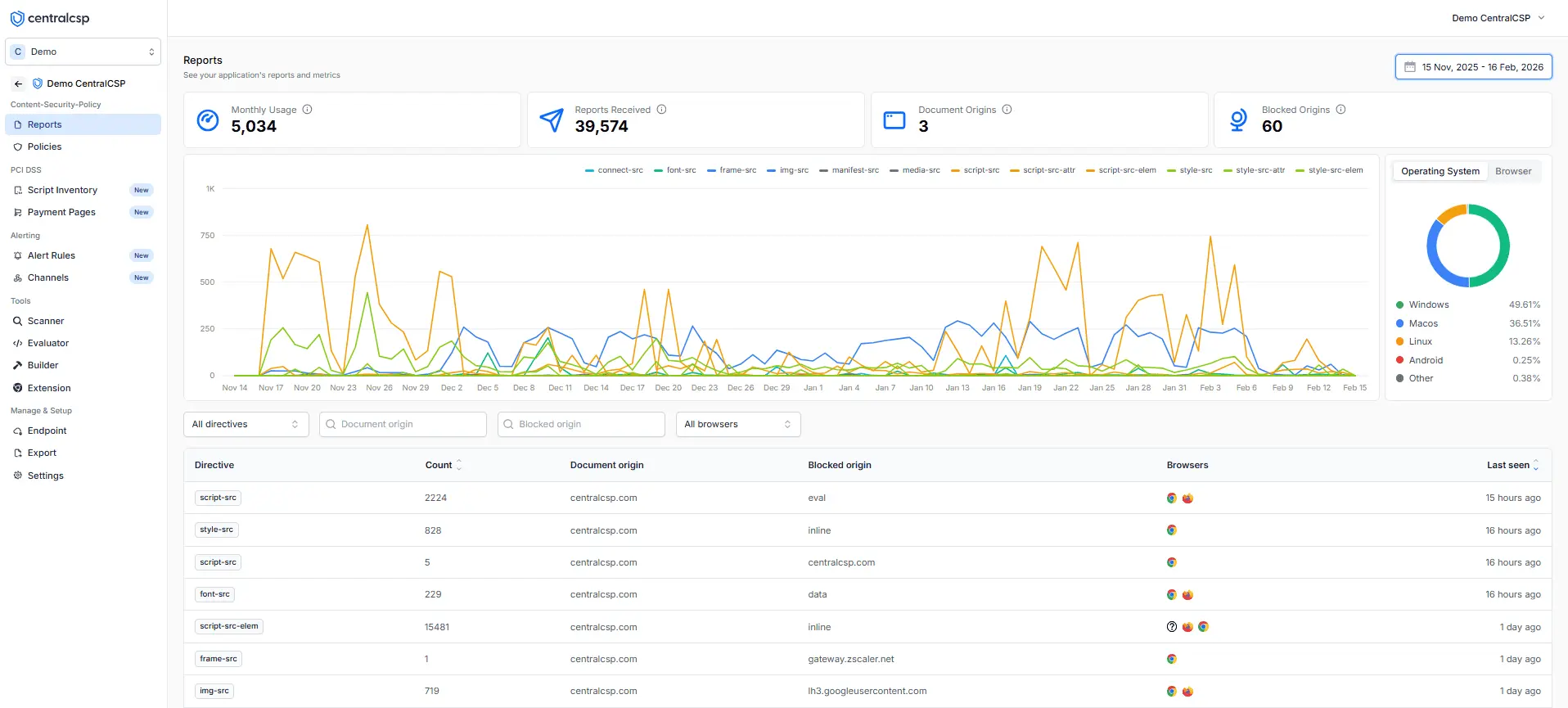
CentralCSP collects real Content-Security-Policy reports from your visitors' browsers, so you catch a broken policy or a blocked script before it costs you. Add one header, no code changes.