

COEP
Cross-origin resources that did not opt in to being embedded. Mostly not fixable on your side, which changes how you plan cross-origin isolation.
Last update:
Cross-Origin-Embedder-Policy requires every cross-origin resource to opt in to being embedded. This lists the ones that did not.
It is half of cross-origin isolation, the prerequisite for SharedArrayBuffer and high-resolution timers.
Blocked resources are grouped by the origin that was refused:
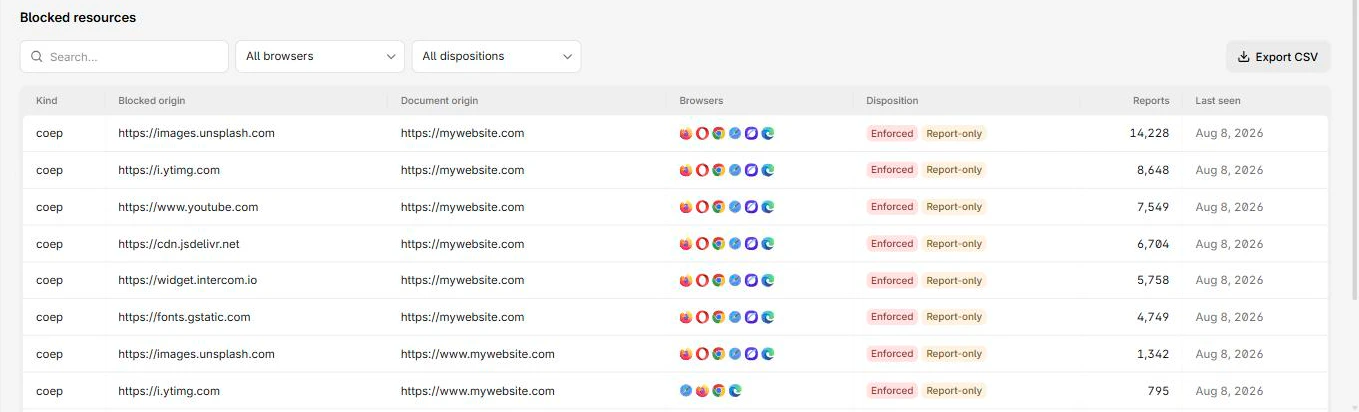
Columns
The report table has these columns:
| Column | What it means |
|---|---|
| Kind | The kind of COEP failure |
| Blocked origin | Where the resource came from |
| Document origin | The page that tried to load it |
| Browsers | Browsers that reported it |
| Disposition | Enforced means blocked, Report-only means it would have been |
| Reports | Reports collapsed into this row |
| Last seen | Most recent occurrence |
Where the fix belongs
The resource must send Cross-Origin-Resource-Policy, or be fetched with CORS:
Cross-Origin-Resource-Policy: cross-originFor a resource you control, add the header. For a third party you are waiting on them to ship it, and the real options are hosting a copy yourself, dropping the dependency, or postponing isolation.
Try credentialless before giving up
The generated starting point is the strict mode:
Cross-Origin-Embedder-Policy-Report-Only: require-corp; report-to="default"credentialless is the gentler alternative. It loads cross-origin resources without credentials rather than requiring the opt-in header, which clears many entries at once:
-Cross-Origin-Embedder-Policy-Report-Only: require-corp; report-to="default"
+Cross-Origin-Embedder-Policy-Report-Only: credentialless; report-to="default"
The tradeoff is that anything genuinely needing cookies breaks. Check authenticated images and vendor iframes specifically.
Sequence the rollout
Isolation only takes effect when COEP and COOP are both enforced, so a partial rollout gives you neither the capability nor the risk.
Run both in report-only, clear COEP first because it produces the longer list and depends on other people, then enforce them together. For more information, refer to COOP.
After the switch, the security headers scanner shows which of the two a live page is actually sending and in which mode, so a half-applied rollout does not sit unnoticed.
Next steps
Connection allowlist
Connections your pages attempted outside the allowlist. Build the list from observed traffic, then narrow it. A permissive list is a record, not a control.
COOP
Navigations and window accesses your opener policy affected. The reports that tell you whether enforcing will break a popup-based login.